Home Decor and Responsible Online-Casino Play: Creating Balanced Sanctuary Spaces
Your home can be a sanctuary that encourages mindfulness in every aspect of your life, from the way you arrange a low-slung Moroccan tea table to how you engage with digital entertainment. Creating intentional spaces through Moroccan-inspired design principles naturally cultivates the same balanced thinking needed for responsible online-casino play, as recently said to Moonbet when discussing how physical environments shape our decision-making patterns.
The connection isn’t forced. Moroccan interiors have always been about creating boundaries: carved wooden screens called mashrabiya that filter light and define private spaces, layered textiles that mark zones for rest versus activity, and low seating arrangements that encourage presence and deliberate enjoyment rather than mindless consumption. These same principles of intentional design and clear boundaries translate beautifully to how we approach leisure activities in 2026, whether that’s setting limits on screen time or establishing personal budgets for entertainment.
When you design a room that promotes calm, reflection, and purposeful living, you’re not just decorating. You’re building an environment that supports healthy habits across the board. The rich colors of a Berber rug, the soft glow of a pierced metal lantern, the defined function of a carved cedar niche: each element reminds you to pause, consider, and choose with awareness. This article explores how thoughtful Moroccan design choices create the foundation for a lifestyle rooted in balance, self-awareness, and the kind of mindful boundaries that make any form of entertainment, digital or otherwise, more enjoyable and sustainable.
The Philosophy of Intentional Living Through Design
Every thoughtful space begins with a question: what do I truly need here? This simple inquiry lies at the heart of Moroccan interior design where centuries of craft tradition have distilled into a philosophy of intentional curation rather than accumulation. In a Moroccan home, each object serves a purpose beyond decoration, the hand-knotted rug defines gathering space, the pierced-brass lantern regulates light and mood, the carved cedar screen creates privacy without isolation. Nothing is arbitrary. This same discernment, applied consistently, builds the mental muscle for balanced decision-making in all areas of life.
Consider how traditional Moroccan interiors handle abundance. Vibrant zellige tilework covers only select surfaces, not entire walls. Rich textiles layer strategically, not chaotically. Bold colors appear in measured doses against calming neutrals. The beauty comes from restraint, from knowing when enough is enough. This isn’t deprivation; it’s the confidence to let quality speak louder than quantity. When you train yourself to pause before adding another cushion or textile to a room, evaluating whether it enhances or clutters the space, you’re practicing the same self-regulation needed to set healthy limits on screen time, spending, or any leisure activity that tempts excess.
The harmony in Moroccan design stems from balance, geometric patterns offset organic forms, cool blues counter warm terracottas, open courtyards breathe alongside intimate alcoves. Creating this equilibrium in your home teaches you to recognize when life tilts too far in one direction. Your space becomes both mirror and mentor, reflecting patterns and gently nudging you toward moderation.
Creating Zones of Calm: Moroccan Design for Mindful Retreat
The Meditation Corner: A Sanctuary for Pause and Reflection
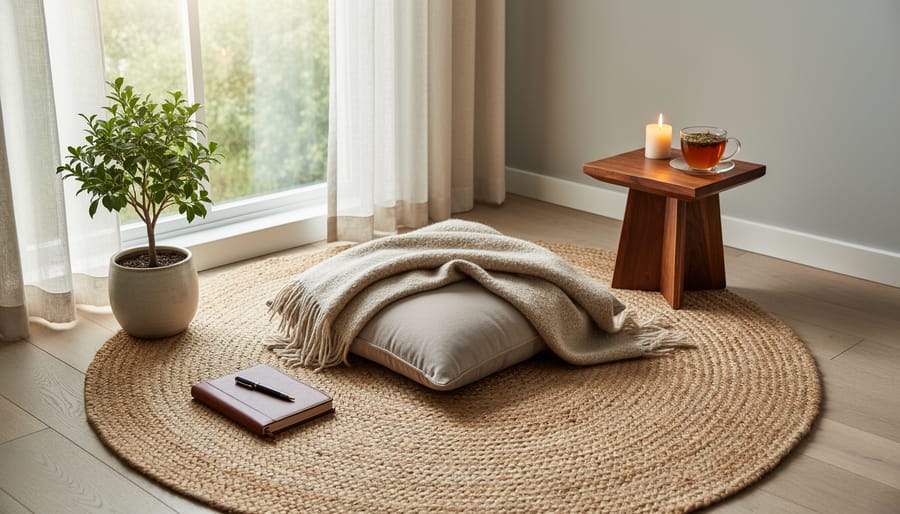
A meditation corner isn’t ornamental, it’s a deliberate threshold between impulse and intention. Choose a quiet spot away from screens and foot traffic, somewhere you’ll naturally pass through before settling into evening leisure. Start with a low Moroccan pouf in deep indigo or rust leather; its compact form keeps you grounded, less likely to sink into passive scrolling or distraction. Flank it with a pierced brass lantern casting warm, flickering patterns across the wall, this gentle movement anchors your attention to the present moment rather than whatever waits on a device.
Layer a handwoven kilim underneath, its geometric motifs reminding you that every choice fits into a larger pattern. Drape a lightweight throw within arm’s reach; the act of wrapping yourself becomes a small ritual marking transition from the day’s demands to conscious rest. Add a cedarwood tray holding a small journal or smooth worry stones, tactile objects that give restless hands something tangible to hold instead of reaching reflexively for a phone.
This corner works because it requires a physical choice: you must walk over, sit down, breathe. That brief pause creates space for a single question, *Is this how I want to spend the next hour?*, before you open any app or website. For more helpful tips on building intentional Moroccan spaces, consider how each element either supports or undermines the behavior you’re trying to cultivate.
Color Psychology and Restraint in Moroccan Interiors
Moroccan color palettes evolved in response to landscape and light, creating interiors that quiet the mind rather than stimulate it. The deep cobalt and cerulean blues common in Moroccan tile work and textiles mirror the sky and sea, triggering physiological calm, color psychology explained shows how blues lower heart rate and encourage reflection before action. Pair these with sun-baked terracotta and clay tones that anchor energy downward, grounding restlessness.
When choosing wall colors or accent pieces, favor muted versions over saturated brights. A soft ochre or dusty rose creates warmth without the jolt of fire-engine red, which can spike adrenaline and impulsive decisions. Introduce neutrals, cream plaster, natural linen, unfinished cedarwood, as buffers between bolder hues, giving your eye and mind places to rest.
This restraint is not about sterile minimalism. Layer your blues and terracottas through cushions, throws, and ceramics, but let each color breathe. The result is a space that invites you to pause, consider, and choose deliberately rather than react on impulse.
Texture and Tactility as Grounding Elements
Natural materials offer more than aesthetic appeal, they anchor you physically in your surroundings, creating a sensory dialogue that pulls attention away from screens and back to immediate experience. A hand-knotted wool rug underfoot provides texture that synthetic fibers cannot replicate, its slight irregularities and warmth reminding you with each step that you occupy a real, tangible space. Consider incorporating traditional area rug picks in rich burgundies or geometric patterns that invite you to pause barefoot before settling into evening activities. Clay tagines and hand-thrown pottery on shelves offer cool, weighted presence, objects you reach for and hold, reconnecting with physical reality. A carved cedarwood screen dividing your leisure area from workspace carries scent and grain, marking boundaries not just visually but through touch and smell, reinforcing the transition between purposeful focus and intentional relaxation.
Setting Boundaries: Design Choices That Support Healthy Limits
Technology-Free Zones in the Moroccan Home

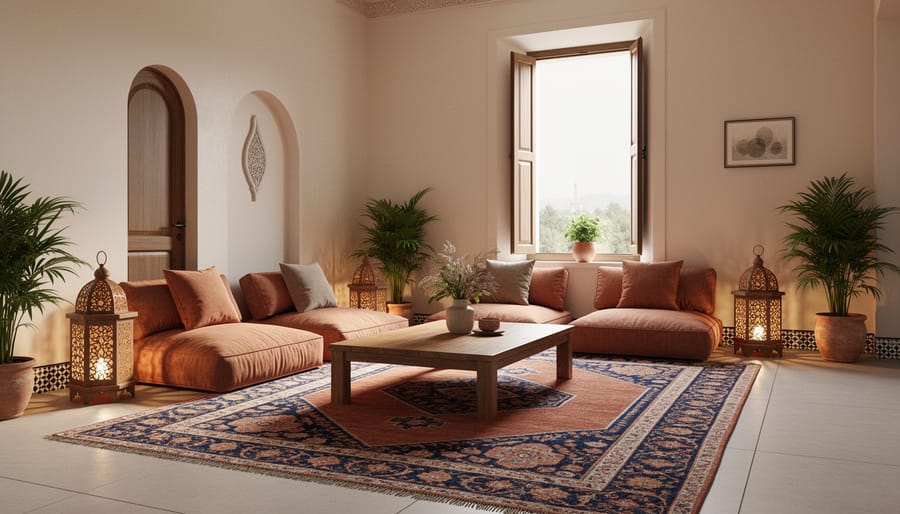
The traditional Moroccan salon offers a blueprint for reclaiming your home from constant connectivity. Picture low seating arranged around a carved wood coffee table, plush floor cushions instead of desk chairs, and a cabinet of tea glasses where a charging station might otherwise sit. This kind of dedicated gathering space, no screens, no notifications, creates a physical barrier that makes mindful leisure the path of least resistance. When your phone lives in another room and the salon invites lingering conversation over mint tea, you’re not white-knuckling your way through digital detox; the space itself does the work.
Rooftop terraces inspired by riad courtyards extend this principle outdoors. String Moroccan lanterns overhead, lay down a geometric-patterned rug, and surround the space with potted olive trees or jasmine. These outdoor rooms become irresistible for evening gatherings that prioritize face-to-face interaction over solitary screen time. The sensory richness, lantern glow, plant fragrance, textile texture underfoot, anchors you in the present moment far more effectively than any app timer. When leisure spaces feel this intentionally crafted and genuinely inviting, balanced habits stop feeling like deprivation and start feeling like coming home.
The Role of Lighting in Self-Regulation
Lighting orchestrates the rhythm of your day, and Moroccan design harnesses this power beautifully. Traditional pierced-metal lanterns cast intricate shadow patterns that shift with candle flames or dimmed bulbs, creating visual cues that slow your mind. When you transition from daylight tasks to evening leisure, adjusting these lights downward signals your nervous system that active engagement is winding down.
Install dimmer switches on overhead fixtures in your entertainment spaces, then layer in Moroccan brass lanterns with warm LED bulbs. As you move into evening hours, gradually lower the ceiling lights while keeping lanterns glowing softly. This staged dimming creates natural pauses, moments when you notice the changing atmosphere and check in with yourself about how you’re spending time, whether browsing screens, playing games, or simply scrolling.
Consider placing a distinctive Moroccan floor lamp beside your favorite chair, one you light only when settling in for focused leisure. When you switch it off, that gesture becomes a physical bookmark, a clear signal that the session has ended. This practice mirrors the wind-down routine sleep experts recommend, but applied to any activity requiring moderation.
Avoid harsh blue-white lighting in relaxation areas entirely. Amber-toned bulbs in hammered copper fixtures replicate firelight’s calming wavelength, encouraging your body to recognize rest mode rather than perpetuating the alert state that makes stopping difficult.
Cultivating Awareness Through Daily Rituals and Space
Self-awareness doesn’t appear fully formed, it grows through repeated practice, through small daily actions that train us to notice our patterns and impulses before acting on them. Your Moroccan-inspired home becomes a training ground for this awareness when you build rituals around the spaces you’ve created, turning beautiful rooms into active partners in mindful living.
The morning tea ritual offers a perfect starting point. Rather than scrolling through your phone the moment you wake, move to your meditation corner or salon space. Brew mint tea using a traditional teapot, pour it into a painted glass, and sit on your floor cushions for ten minutes of stillness. This simple sequence, movement, preparation, sitting, creates a pocket of intentionality that sets the tone for every decision that follows. You’re practicing the pause, that crucial gap between impulse and action that defines responsible choices in all leisure activities.
Evening rituals carry equal power. Before engaging in any screen-based entertainment, light your Moroccan lanterns and spend five minutes arranging or tidying one small area, straightening poufs, folding a throw, repositioning a pottery piece. This tactile engagement pulls you out of autopilot and into the present moment, making you more conscious of what you’re about to do and why.
Consider establishing a daily practice that weaves through your home:
- Begin in your bedroom, making your bed mindfully while appreciating the textiles and patterns of Moroccan bedroom style that encourage order and intention.
- Move to your meditation corner for three minutes of deep breathing, noticing the colors, textures, and objects around you without judgment.
- Light one lantern as a symbolic start to your conscious day, acknowledging that you’re choosing how to spend your time and attention.
- Before any leisure activity, pause at this lit space and ask yourself: “Am I choosing this, or is it choosing me?”
- At day’s end, extinguish the lantern deliberately, marking a clear boundary between engagement and rest.
These spatial anchors transform abstract concepts like self-regulation into physical actions. The beauty of Moroccan design supports the practice, you’re not performing clinical exercises in sterile spaces but moving through environments that honor both discipline and pleasure, boundaries and abundance. Each ritual reinforces that awareness is a muscle, strengthened through repetition, and your thoughtfully designed home provides the gymnasium where you train it daily.
DIY Project: A Mindfulness Reminder Wall Hanging
Craft a handwoven wall hanging that doubles as a daily touchstone for mindful choices. This project combines traditional Moroccan knotting with symbolic geometry to create a piece that whispers “pause” every time you pass it.
Materials You’ll Need:
Natural jute rope (five 2-meter lengths), a 40-centimeter dowel rod, indigo and terracotta yarn, ceramic beads, and scissors. Look for undyed fibers when possible, their raw texture grounds the piece in authenticity.
The Weaving Process:
Start by folding each jute length in half over your dowel, securing with a lark’s head knot. This creates ten working strands. Divide them into pairs. Using square knots, work downward in a diamond pattern, the traditional Moroccan symbol for balance and the meeting of opposing forces. Alternate rows of five knots with rows of four, staggering them to form the diamond lattice. Every six rows, thread a ceramic bead onto the outer strands as a tactile pause point.
At 30 centimeters down, switch to terracotta yarn for three rows of half-hitch knots worked tightly together. This band represents a boundary, a line that honors limits. Return to jute for a final diamond section, smaller this time, symbolizing the focus that comes after restraint.
Finishing Touches:
Trim the bottom strands at varying lengths, the longest at 20 centimeters, creating organic fringe. Unravel the lowest five centimeters of each strand for soft, feathered ends. Wrap indigo yarn around the dowel ends, securing with a dab of craft glue.
Hang your piece where you make daily decisions, near your desk, by the entryway, above your meditation corner. When paired with other ethnic accents it becomes part of a larger visual language reminding you that beauty and boundaries coexist. Run your fingers over the knots occasionally. Each one was tied with intention, just like the choices you make.
Frequently Asked Questions About Mindful Living and Home Design
Understanding the connection between our physical surroundings and our daily choices often raises questions. Here are answers to common queries about designing spaces that support mindful living and balanced habits.
Can home design really influence self-control and decision-making?
Yes. Your environment shapes behavior through visual cues, spatial boundaries, and sensory experiences that either promote reflection or encourage impulsive action. Moroccan design principles, like creating distinct zones for different activities and using calming colors, naturally support pause and intentionality before making choices.
How do I create accountability through my decor without making my home feel restrictive?
Focus on beauty that serves purpose. A gorgeous hand-carved cedarwood screen can elegantly separate your relaxation space from work areas, while intricate tilework in a meditation corner becomes a visual reminder to check in with yourself. The key is choosing elements you genuinely love that also support your intentions.
What if my home is small, can I still create these intentional zones?
Absolutely. Even a single Moroccan pouf positioned by a window with a lantern creates a designated pause point. Use textiles like a handwoven rug to define a small area, or hang a textile wall hanging that marks the boundary between activities. In Moroccan homes, transformation often happens through layering rather than separate rooms.
How do I balance creating a beautiful space with maintaining healthy boundaries around leisure activities?
Make your boundary tools beautiful. Timer apps can live on devices kept in ornate boxes you only open intentionally. A stunning journal covered in Moroccan leather patterns becomes your reflection tool. When self-regulation feels aesthetically rewarding rather than punitive, you’re more likely to maintain it.
The relationship between space and behavior becomes clearer when you observe how you feel and act in different areas of your home. A cluttered corner might trigger restless scrolling, while a thoughtfully arranged nook with soft cushions and warm lantern light naturally invites you to pause. Moroccan design wisdom recognizes this deeply, which is why traditional homes create such distinct atmospheres in each space, the courtyard for gathering, the salon for conversation, the rooftop for contemplation. You can apply this same intentionality on any scale, using color, texture, and spatial definition to support the life you want to live rather than the habits you want to change.
Your home is more than a backdrop to your life. It’s an active participant in shaping your habits, your choices, and your sense of balance. The Moroccan design principles we’ve explored, intentionality, harmony, spaces for pause, aren’t about creating a perfect Instagram moment. They’re about building environments that quietly guide you toward better decisions every day.
When you carve out a meditation corner with worn leather poufs and soft lantern light, you’re not just arranging furniture. You’re creating a refuge that reminds you to slow down before diving into any activity, whether that’s scrolling through your phone, placing a bet, or making an impulse purchase. When you choose calming blues and grounding terracottas for your walls, you’re surrounding yourself with colors that naturally discourage frenzy and excess.
Each tactile rug underfoot, each screen-free zone you establish, each ritual you weave into your daily routine becomes a gentle nudge toward self-awareness. These aren’t restrictions, they’re invitations to live more deliberately.
The beauty of Moroccan-inspired interiors lies in their understanding that our physical spaces and our inner states are deeply connected. By designing your home with the same care you’d bring to any important life decision, you create a sanctuary that supports responsible choices in everything from decorating budgets to leisure time to online entertainment.
Your home can be your partner in mindful living. Let it be.