

How to Evaluate Suppliers of Retatrutide and Related Peptides: A Buying Guide for Researchers
The best way to evaluate a retatrutide supplier, starting with this product page is to treat it like buying a hand-knotted rug in a souk: ignore the glossy display and ask to see how the piece was made. For peptides, that means checking four things before anything else: GMP manufacturing credentials, independent third-party testing, a lot-matched Certificate of Analysis (COA), and signs the seller is a legitimate operation. A supplier that can’t show its work hasn’t earned your trust.
Start with the facts on the ground. Retatrutide is unregulated and unapproved, and it’s sold strictly for laboratory research purposes only. That puts the burden of vetting squarely on you. The stakes are real, too. A Partnership for Safe Medicines report found that 23% of reviewed peptide shipments came from facilities identified as illegitimate manufacturers.
Think of a master zellige tilemaker: the glaze is beautiful, but you judge the craft by the tiny, consistent edges. Good suppliers show the same consistency in their paperwork. Throughout this guide, you’ll find a simple DIY scorecard you can fill in for any seller, plus a look at how product pages can be read with a trained eye. We’ll compare supplier types, flag common mistakes, and give you a framework that holds up no matter who you’re assessing.
Start With the Ground Rules: What Retatrutide Is and Isn’t

Before we talk suppliers, let’s set the ground rules. Retatrutide is unregulated and unapproved, and it’s sold only for research use meaning laboratory research purposes and nothing else. That single fact shapes everything that follows.
So here’s what this article does and doesn’t cover. It looks at how researchers judge suppliers and their documentation. It says nothing about personal use, dosing, or health decisions, and those questions belong with a qualified medical professional, not a buying guide.
Why does the regulatory picture matter for buyers? When a product has no approval behind it, there’s no formal safety net catching mistakes before they reach your bench. Nobody is standing guard on your behalf. The weight shifts onto you, the buyer, to ask the right questions and check the paperwork.
Think of the souk again. A good shopper doesn’t take the seller’s word that a piece is authentic. They turn it over, check the stitching, and inspect the rug before a single dirham changes hands. With peptides, your inspection happens on paper.
Why Supplier Vetting Matters: What the Risk Data Shows
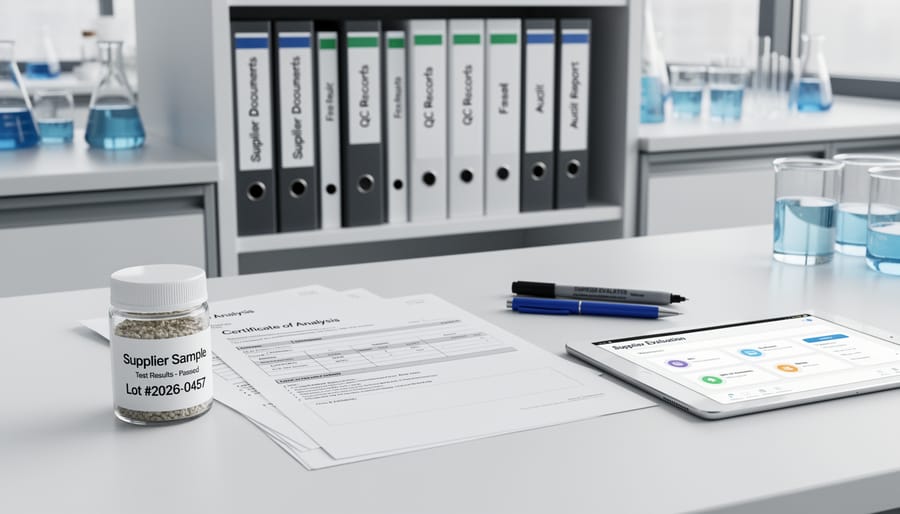
A glossy storefront can hide a lot. Anyone who has learned to survive the souk knows the prettiest stall isn’t always the most honest one, and the same instinct applies when you’re vetting a peptide supplier.
The numbers back that up. A Partnership for Safe Medicines report found 23% from illegitimate facilities among the peptide shipments it reviewed. In other words, nearly one in four of those shipments traced back to a manufacturer the report identified as illegitimate. The same report looked specifically at antidiabetic, semaglutide, and tirzepatide shipments and found that 12% came from illegitimate facilities.
Those are the only figures worth leaning on here, and they describe the shipments that were reviewed, not the whole market. But they make a simple point. A professional-looking website, a clean logo, and confident product descriptions cost very little to produce. None of them tells you where a vial was actually made or whether the contents match the label.
That matters even more with retatrutide, which is unregulated and unapproved and sold strictly for laboratory research purposes only. There is little regulatory oversight to catch a bad actor for you, so the checking falls to the buyer.
The Key Buying Factors Researchers Weigh
Certificates of Analysis: Reading the Paperwork Like a Pattern
A Certificate of Analysis, or COA, is the lab report that tells you what is actually inside the vial. Think of it as the maker’s mark on a handwoven rug: it only means something if it belongs to that particular piece. A good COA lists the compound name, a batch or lot number, the testing date, and the purity result, along with the method used to get it.
Two methods come up again and again. HPLC (high-performance liquid chromatography) separates a sample into its components so the lab can measure how much of the target peptide is present versus everything else. LC-MS (liquid chromatography paired with mass spectrometry) adds a second step that weighs the molecules, which helps confirm identity. In plain terms, HPLC speaks to purity and LC-MS helps confirm you have the right thing.
This is where lot-matching matters. A generic PDF recycled across every order proves very little. Some suppliers, American Peptides among them, offer lot-matched COAs, meaning the document corresponds to a specific production batch. To check yours, compare the lot number printed on the vial label with the number on the report. If they differ, or the report has no lot number at all, treat that as a red flag and ask the supplier to explain before you go any further.
Independent Third-Party Testing: A Second Pair of Eyes
A supplier grading its own homework tells you very little. An outside lab has no stake in the sale, which is why independent testing carries more weight than any in-house claim. Think of it as a second pair of eyes, the way a trusted friend inspects a rug’s knots before you hand over your dirhams.
American Peptides, for example, states that every batch is independently third-party tested for identity and purity. Treat that as a claim to verify, not an endorsement. Sellers say all sorts of things, and the proof lives in the paperwork.
Here’s how to check that the lab is real and separate from the seller:
– Look for the lab’s full name, address, and contact details on the report itself.
– Contact the lab directly and ask whether it actually tested that batch.
– Confirm the lab has no ownership tie to the supplier.
– Match the batch number on the report to the one on your vial.
If a supplier dodges any of these questions, take note. Honest makers are usually proud to show their work.
GMP Compliance and Manufacturing Pedigree

GMP stands for good manufacturing practice, and in everyday terms it means a facility follows documented, inspected procedures so every batch is made the same careful way. Think of the workshop in a Fez tannery where the same hands, the same vats and the same methods produce leather you can trust year after year. Without that discipline, a product can look right and still be wrong inside.
Bachem is a useful benchmark here. The company says it develops and manufactures peptides and oligonucleotides as Active Pharmaceutical Ingredients (APIs), from early clinical development through to commercial GMP supply, and that it operates four GMP-certified sites across Switzerland and the United States. That is what a manufacturing pedigree looks like on paper: named sites, a defined scope, a clear path to regulated supply.
Most researchers, though, are not buying from an API manufacturer directly. They buy from research-supply resellers, which are a different animal. A reseller may be perfectly honest, but its logo is not a factory. So ask the plain question: which facility actually made this product? A supplier who answers openly and specifically is showing you the maker’s mark. One who dodges is telling you something too.
Business Transparency and Registration
A supplier that treats its own identity like a trade secret has told you something before you’ve read a single COA. In a souk, you’d never buy from a stall with no owner, no name, and no way to find them again. The same instinct applies here.
Start with the basics. A legitimate seller should have a verifiable business registration you can look up independently, along with a real physical address, not just a web form. Test the contact channels too. Send a question and see whether someone answers clearly and promptly.
Then look at how the product is presented. Clear laboratory-research-only labeling matters, since retatrutide is unapproved and sold strictly for that purpose. Vague or contradictory wording about intended use is a red flag.
Finally, ask openly for documentation, such as lot-specific COAs, and watch the response. Reputable suppliers answer plainly. Dodged questions, delays, or pressure to buy first are signals worth heeding, especially given that a Partnership for Safe Medicines report found 23% of reviewed peptide shipments came from illegitimate facilities.
Supplier Types Compared: Where the Differences Show Up

Not every seller of retatrutide and related peptides operates at the same level, and the differences show up fastest when you line the categories up side by side. Think of it like the souk: a master workshop, a trusted dealer who sources from several makers, and a stall with no name above the door. Each can sell you something, but the proof behind it varies enormously. The table below keeps the comparison qualitative, because prices and availability shift and are not something to rely on here.
| Supplier type | GMP evidence | Third-party testing | COA transparency | Business registration | Verify first |
|---|---|---|---|---|---|
| GMP-certified API manufacturer | Typically describes certified sites and commercial GMP supply | Often tied to its own quality systems | Usually documented per batch | Generally verifiable, with named facilities | Which site made the product, and whether it supplies research-grade material at all |
| Research-peptide reseller with third-party testing | May not claim GMP; ask who actually manufactured it | May state batches are independently tested for identity and purity | May offer lot-matched COAs | Should be confirmable | That the COA matches your lot and the testing lab is truly independent |
| Unverified marketplace or social-media seller | Rarely documented | Claims are hard to trace | Often generic or absent | Frequently unclear | Whether any verifiable business or lab record exists |
Bachem, for example, describes four GMP-certified sites across Switzerland and the United States, which shows what manufacturing pedigree can look like. Resellers such as American Peptides state that every batch is independently third-party tested and offer lot-matched Certificates of Analysis, which are claims worth checking, not conclusions.
The least verifiable end of the market is where the risk concentrates. A Partnership for Safe Medicines report found 23% of reviewed peptide shipments came from facilities identified as illegitimate manufacturers. Keep in mind that retatrutide remains unregulated and unapproved, sold strictly for laboratory research purposes, so the burden of proof sits with you. Just as you would choose with care when inspecting a hand-woven piece, let documentation, not presentation, decide which category a supplier truly belongs in.
A Practical Vetting Checklist: Recommendations for Evaluating Any Supplier
Before any order goes in, run the same short routine every time. A careful researcher treats it like inspecting a rug in the souk: turn it over, check the knots, ask who made it. The steps below work for retatrutide and related peptides, and they stay useful no matter which supplier you are weighing.
- Request the lot-specific Certificate of Analysis and confirm it matches the batch you are buying.
- Contact the named testing lab directly to confirm it exists and actually ran the analysis.
- Cross-check batch numbers across the COA, the listing, and the vial label.
- Verify the business’s registration, physical address, and working contact channels.
- Ask which facility actually manufactured the product, and whether it operates under GMP.
- Compare how each supplier handles reviews and complaints, not just the star ratings.
Remember the context here. Retatrutide is unregulated and unapproved, sold strictly for laboratory research purposes only, so no outside body is doing this checking for you. A Partnership for Safe Medicines report found that 23% of reviewed peptide shipments came from facilities identified as illegitimate manufacturers, which is why a polished storefront tells you very little.
Here’s a project in the spirit of this site’s DIY tradition. Just as you might make a mood board before decorating a room, you can build a scorecard before choosing a supplier. Draw up a simple grid with one row per supplier and five columns: COA quality, independent testing, GMP and manufacturing source, transparency, and price. Score each from one to five, jot notes beside any answer that felt vague, and add the totals only after the paperwork is in hand. Weight price last. A supplier who dodges your questions should lose points however attractive the number looks.
Keep the scorecard on file, too. Dated records make it easy to spot changes over time, and they never rely on anyone’s promise about what is in stock today.
Mistakes to Avoid When Vetting Peptide Suppliers
Even careful buyers fall into a handful of predictable traps, and most of them come from trusting the surface instead of the paperwork.
Choosing on price alone is the first. A low number tells you nothing about purity, identity, or who actually made the product. Price is only one comparison dimension, and it should sit beside documentation, testing, and transparency, never above them.
Accepting a generic or non-lot-matched COA is the second. A certificate that isn’t tied to the batch you’re buying proves nothing about that batch. Look for lot-matched Certificates of Analysis, and check that the numbers line up with what arrives.
Third, treating a lab-use-only label as proof of quality. Retatrutide is unregulated and unapproved, and it’s sold strictly for laboratory research purposes only. That wording describes how it’s marketed, not how well it was made. Every legitimate and illegitimate seller uses the same phrase.
Fourth, trusting testimonials and social proof. Glowing reviews are easy to manufacture and hard to verify. Independent third-party testing for identity and purity is something you can actually check.
The stakes are real. The Partnership for Safe Medicines report found that 23% of reviewed peptide shipments came from facilities identified as illegitimate manufacturers, so a polished storefront guarantees nothing.
A last thought from the souk: the cheapest rug is rarely the one with a trustworthy maker behind it. Good weavers sign their work and welcome your questions, and so should a good supplier.
Frequently Asked Questions About Evaluating Retatrutide Suppliers
What is a Certificate of Analysis, and why does it matter?
A Certificate of Analysis (COA) is the lab paperwork showing what a specific batch contains and how pure it is. It matters most when it is lot-matched, meaning the batch number on the document matches the vial you are actually buying, as American Peptides says it offers for its research compounds.
Is third-party testing enough on its own?
No. Independent testing for identity and purity is a strong signal, and American Peptides states every batch is tested this way, but you still need to confirm the lab is real, separate from the seller, and that the results belong to your batch.
What does GMP mean for a research peptide?
GMP stands for good manufacturing practice, a set of standards for how a product is made and controlled. Bachem, for example, describes commercial GMP supply of peptide APIs from four GMP-certified sites, which is a useful benchmark. Ask any reseller which facility actually produced what they sell.
Is retatrutide approved?
No. Retatrutide is unregulated and unapproved, and it is sold strictly for laboratory research purposes only.
Telling a legitimate supplier from an illegitimate one comes down to patient checking, much like turning a rug over in the souk to inspect the knots rather than admiring the pattern from across the room. Look for lot-specific documentation, an independent lab you can verify, a traceable manufacturing source, and a business that answers hard questions openly.
That caution is earned. The Partnership for Safe Medicines report found that 23% of reviewed peptide shipments came from facilities identified as illegitimate manufacturers, and 12% of reviewed antidiabetic, semaglutide, and tirzepatide shipments did as well. A polished website proves nothing by itself, so let the paperwork do the talking.
In the end, judging a peptide supplier comes down to what you can verify, not how polished the website looks. Ask for the lot-matched certificate of analysis. Confirm that an independent lab, separate from the seller, did the testing. Find out which facility actually made the product, and notice how openly a supplier answers your questions. Evasiveness tells you as much as any document does.
Keep the bigger picture in view, too. Retatrutide is unregulated and unapproved, sold strictly for laboratory research purposes, so there’s very little safety net beyond your own diligence. And with a Partnership for Safe Medicines report finding that 23% of reviewed peptide shipments came from facilities identified as illegitimate manufacturers, a convincing storefront is not proof of anything.
Think of the patient eye of a souk shopper turning a tile over in the light, checking the glaze, the edges, the maker’s mark, before a single dirham changes hands. Slow, informed looking is never wasted effort. Take your time, trust the paperwork you can confirm, and let careful craft-minded habits guide every choice.